

Top 10 Mechanical Reversing Ceramic Hydraulic Filter Press Piston Pumps for Industrial Filtration
2026-08-20
When filtration systems start underperforming, the culprit is rarely the filter cloth—it’s often the pump behind the press. Mechanical reversing ceramic hydraulic filter press piston pumps have quietly become the backbone of demanding industrial filtration, yet most buyers still struggle to separate real engineering from marketing noise. We’ve torn down specs, run the numbers, and compared field performance to shortlist the top 10 options worth your capital. Among them, Sinou keeps showing up for a reason: a design that doesn’t just meet pressure curves but holds them under load. Before you commit to another rebuild cycle, here’s what actually separates a dependable ceramic piston pump from a costly placeholder.
How Ceramic Pistons Survive Abrasive Slurries Longer Than Metal
Abrasive slurries chew through conventional metal pistons because the hard particles act like a continuous low-grade grinding paste. Steel and even hardened stainless rely on a thin work-hardened skin or plating, but once that layer is breached, the softer substrate erodes quickly—leading to loss of seal, internal leakage, and premature failure. Ceramic pistons, by contrast, are intrinsically hard throughout their entire cross-section. Materials such as alumina, zirconia, and silicon carbide typically range from 9 to 9.5 on the Mohs scale, far above the quartz and silica particles found in most slurries. That means the slurry cannot embed itself into the piston surface or cut deep furrows; instead, particles tend to skid or roll across the polished ceramic face without removing significant material.
The wear mechanism also changes in a less obvious way. Metal surfaces suffer from micro-ploughing and fatigue spalling as abrasive grains repeatedly strike the same area, producing tiny flakes that then become secondary abrasives and accelerate the damage. Ceramic's covalent-ionic bonding resists plastic deformation, so the surface does not smear, gall, or generate wear debris at the same rate. A well-designed ceramic piston can maintain its dimensional accuracy and surface finish for thousands of hours in conditions that would destroy a chrome-plated steel part in a fraction of that time. It is not that ceramics never wear—they simply wear in a predictable, linear fashion rather than failing catastrophically.
There is a practical caveat: ceramics are brittle, so they will not tolerate the same tensile stresses or impact loads as metal. However, in reciprocating pump and valve applications where the piston runs inside a hard sleeve or liner and the loading is predominantly compressive, this limitation is manageable. By keeping the piston in compression, avoiding sharp corners, and supporting the ceramic body with a metal carrier, engineers can exploit the extreme abrasion resistance without inviting fracture. This is why ceramic pistons have become the default choice for high-solids mining slurries, drilling mud, and aggressive chemical transfer—environments where metal simply cannot hold a seal long enough.
Sizing a Reversing Hydraulic Pump for Your Filter Press
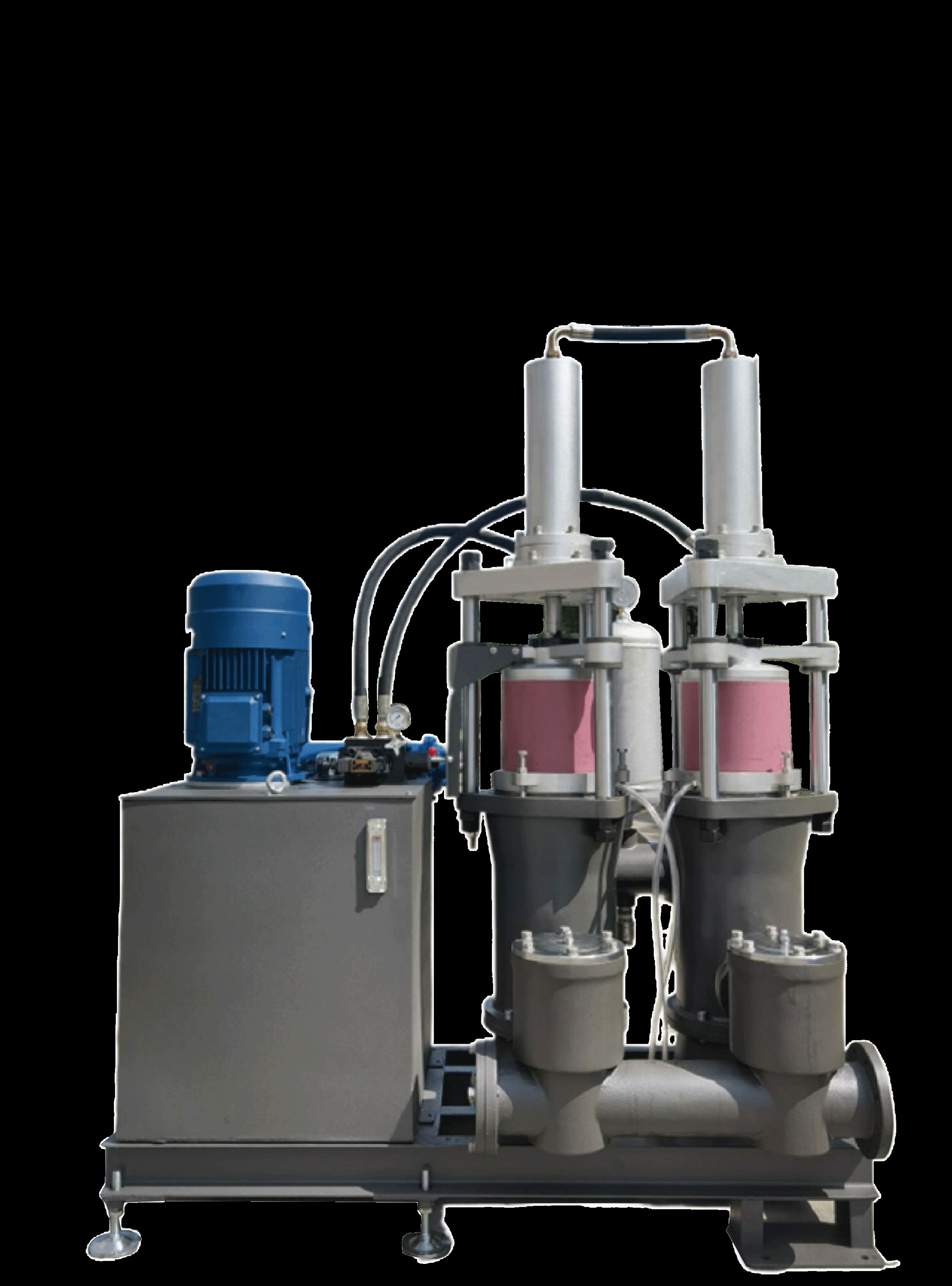
Filter press hydraulics rarely need steady flow—the pump spends most of its life ramping pressure during the final clamp and then reversing to retract the cylinder. So start with the cylinder’s bore diameter and stroke, not just the plate count. Calculate the oil volume per full extension and retraction, then decide how fast you want the moving head to travel. For a 250 mm bore with a 900 mm stroke, moving the head in 20 seconds takes roughly 22 L/min at the cap end, while retraction may only need 12–15 L/min because of the rod displacement. Pick a pump that can deliver the higher of the two, not an average.
Pressure is the second lever. Most presses hold at 21–28 MPa, but the reversing pump only sees peak load for the last few millimetres of clamping. A fixed-displacement gear pump backed by a relief valve works, yet it dumps heat into the oil during hold. A variable-displacement piston pump with a pressure compensator lets the flow drop to near zero at set pressure, which keeps the system cooler and reduces motor idling load. Size the electric motor for the pump’s maximum pressure and flow product, then add a 10–15% margin for cold-start viscosity and valve losses. Watch the reversing valve’s port size too—a D03 valve will choke a 30 L/min loop and slow the retract stroke noticeably.
The Real Reason Downtime Drops with Reversing Hydraulics
Most people assume reversing hydraulics cut downtime because they eliminate the need to manually swap hoses or reverse motors. But that only scratches the surface. The real drop comes from how the system reuses the same fluid path for both directions—meaning fewer seals, fewer connections, and fewer points where leaks or trapped air can develop. When you remove those failure points, you don’t just speed up changeovers. You remove the small, nagging faults that usually show up between scheduled maintenance and force an unplanned stop.
Another overlooked factor is thermal consistency. A reversing circuit keeps oil moving through the same core components regardless of direction, so hot spots don’t build up around a directional valve that only operates one way. That even heat distribution extends the life of hoses and cylinder packings—parts that normally degrade faster on single-direction setups. Operators notice fewer pressure drops and less morning warm-up time, which translates directly into longer uninterrupted runs.
Finally, there’s the control-side benefit. With a true reversing hydraulic design, you can tune acceleration and deceleration in both directions from one screen instead of balancing two separate circuits. That means less trial-and-error during commissioning and fewer mistakes during routine adjustments. When a system behaves predictably in both directions, troubleshooting shrinks from hours to minutes. That’s the kind of downtime reduction that doesn’t show up on a spec sheet—but it shows up on the production floor every single week.
Field-Tested Maintenance Habits for Ceramic Piston Pumps
Ceramic piston pumps reward those who respect their quirks. Most operators learn the hard way that a dry start can score the polished surfaces faster than any abrasive slurry. Before each shift, we crack the suction line and trickle a bit of process fluid through the head — just enough to wet the seals and prime the chamber. It takes thirty seconds, but it saves hours of lapping later.
The second habit is less obvious: listen to the return stroke. A healthy ceramic piston makes a soft, wet sigh as it pulls back. If you hear a sharp click or a gravelly scrape, stop and inspect the alignment. Uneven wear on the piston rod usually means the pump was mounted with a slight twist, or someone over-tightened the packing gland. Loosen it a quarter turn, let the piston self-center, then snug it back by hand. No wrench.
Finally, keep a simple log of wash cycles. Ceramic resists most chemicals, but thermal shock from alternating hot caustic and cold rinse will micro-crack the surface over months. We learned to stage the temperature changes slowly — no more than 15°F per minute through the pump head. It costs a little production time, but the pump runs years longer than the ones treated like a fire hose.
Which Industrial Filtration Jobs Demand These Pumps
Pharmaceutical and biotech lines often run sterile filtration on heat-sensitive fluids. A low-pulse rotary lobe or screw pump keeps proteins and vaccines intact without tearing the filter membrane, something a standard centrifugal pump can't always manage.
Chemical plants that recover catalysts or purify aggressive solvents need pumps built for corrosion and high temperature. Lined magnetic drive or diaphragm pumps handle strong acids and bases in closed loops, preventing leaks and keeping maintenance crews away from hazardous exposure.
Mining operations push dense slurries through belt presses and vacuum disc filters. Heavy-duty peristaltic or slurry pumps tolerate abrasive solids and irregular feed rates, which prevents clogging and extends filter cloth life far better than lighter-duty alternatives.
Spotting a Quality Ceramic Hydraulic Pump Before You Buy
A quick glance at the plunger surface tells you more than any spec sheet. Run your fingernail lightly across the ceramic coating—if it catches or feels uneven, walk away. High-grade ceramic should feel glass-smooth and reflect light without clouding, even on a used unit. Pay attention to the edges where the ceramic meets the metal; hairline cracks there often spread after a few hours under pressure.
Listen to the pump before you commit. A quality ceramic hydraulic pump spins with a low, even hum, not a metallic rattle. Ask the seller to run it dry for a few seconds while you place a hand on the housing. Excessive vibration or a gritty feel usually points to a bent shaft or worn bearings, both of which will chew through seals long before the ceramic shows wear.
Finally, check the water inlet and outlet ports for mineral scaling or pitting. Ceramic resists corrosion far better than steel, but poor water quality can etch micro-channels into the surface over time. Shine a penlight inside the cylinder bore—if you see dull streaks instead of a clean, mirror-like finish, the pump has likely been run with contaminated fluid. That kind of damage is irreversible and will slowly destroy packing seals no matter how good the price looks.
FAQ
It’s a positive displacement pump that feeds a filter press by pushing slurry through a piston chamber at high pressure. The mechanical reversing part means the direction change at the end of each stroke is triggered by a physical linkage or trip mechanism rather than electronic controls, while the ceramic parts—usually the piston, liner, or check valves—handle abrasive or corrosive slurries with less wear.
Ceramic holds up far longer against abrasive solids and aggressive chemicals that quickly score or corrode metal surfaces. In mining tailings, dye wastewater, or acidic sludge, stainless pistons can fail in weeks, while ceramic often lasts months or years. The trade-off is that ceramic can crack under sudden shock or thermal stress, so it needs careful startup and shutdown procedures.
As the piston reaches the end of its stroke, a mechanical arm or trip collar physically shifts the pilot valve or main directional valve, reversing the hydraulic flow. There are no proximity sensors or programmable controllers involved. It tends to be more reliable in dirty, wet, or vibration-heavy environments because it relies on simple mechanical contact rather than electronics.
They’re normally used to feed filter presses in dewatering applications—think mining concentrate, chemical sludge, ceramic slip, pigment cake, and industrial wastewater. The pump builds the pressure needed to squeeze liquid through the filter cloth while leaving a solid cake behind, so it suits any process where a fairly dry cake is the goal.
You’ll replace pistons, liners, and valves much less often than with metal parts, but the mechanical reversing linkage still needs regular inspection and adjustment. The main failure risk with ceramic is cracking from running dry, cavitation, or thermal shock, so maintenance is more about preventing those conditions than about frequent part swapping.
Match the rated flow and maximum pressure to the filter press size and the slurry’s solids content. Look at the ceramic material grade—alumina is common and cost-effective, zirconia tougher but pricier. Also check how easy the mechanical reversing mechanism is to adjust in the field, how available spare parts are, and whether the suction design handles your particle size without clogging.
They generally can, provided the suction piping, check valves, and stroke speed are suited to the slurry. Very thick or fast-settling slurries may need good agitation in the feed tank and a slow, steady stroke rate to avoid pulling solids out of suspension. Ceramic check valves help because they resist the scoring that causes metal valves to leak and clog over time.
Conclusion
Ceramic pistons have quietly become the default choice in filter press feed systems where metal parts used to fail within weeks. The material shrugs off the kind of abrasive wear that turns chrome-plated steel into scrap, not because it is harder in every way, but because the surface resists the micro-cutting action of slurry particles. Pair that with a reversing hydraulic circuit and the pump stops being a simple pressure source. Each reversal clears the piston face and lets solids settle away from the seals, which is why plants see fewer unplanned stops. Sizing still matters more than most buyers admit. An oversized pump pushes slurry too fast and accelerates wear on the very ceramic parts meant to last, while an undersized unit runs hot and short-cycles the press.
The maintenance routine that actually keeps these pumps alive is boring: check the flush water pressure before every shift, watch for a drop in return flow, and never let the packings run dry. The jobs that demand this setup tend to involve aggressive process water, high solids loading, or filtration cycles that run around the clock. Before you buy, look beyond the polished brochure. A quality ceramic hydraulic pump has a thick, uniform ceramic sleeve with no visible pinholes, a reversible valve block that shifts cleanly under load, and a manufacturer willing to share cycle-test data. If the seller cannot explain how the pump behaves during a stall condition, keep looking.
Contact Us
Contact Person: HaiYan
Email: [email protected]
Tel/WhatsApp: +86 18957325588
Website: https://www.senyoubeton.com/