

Custom Surge Protective Devices: Tailored Protection for Critical Electrical Systems
2026-09-02
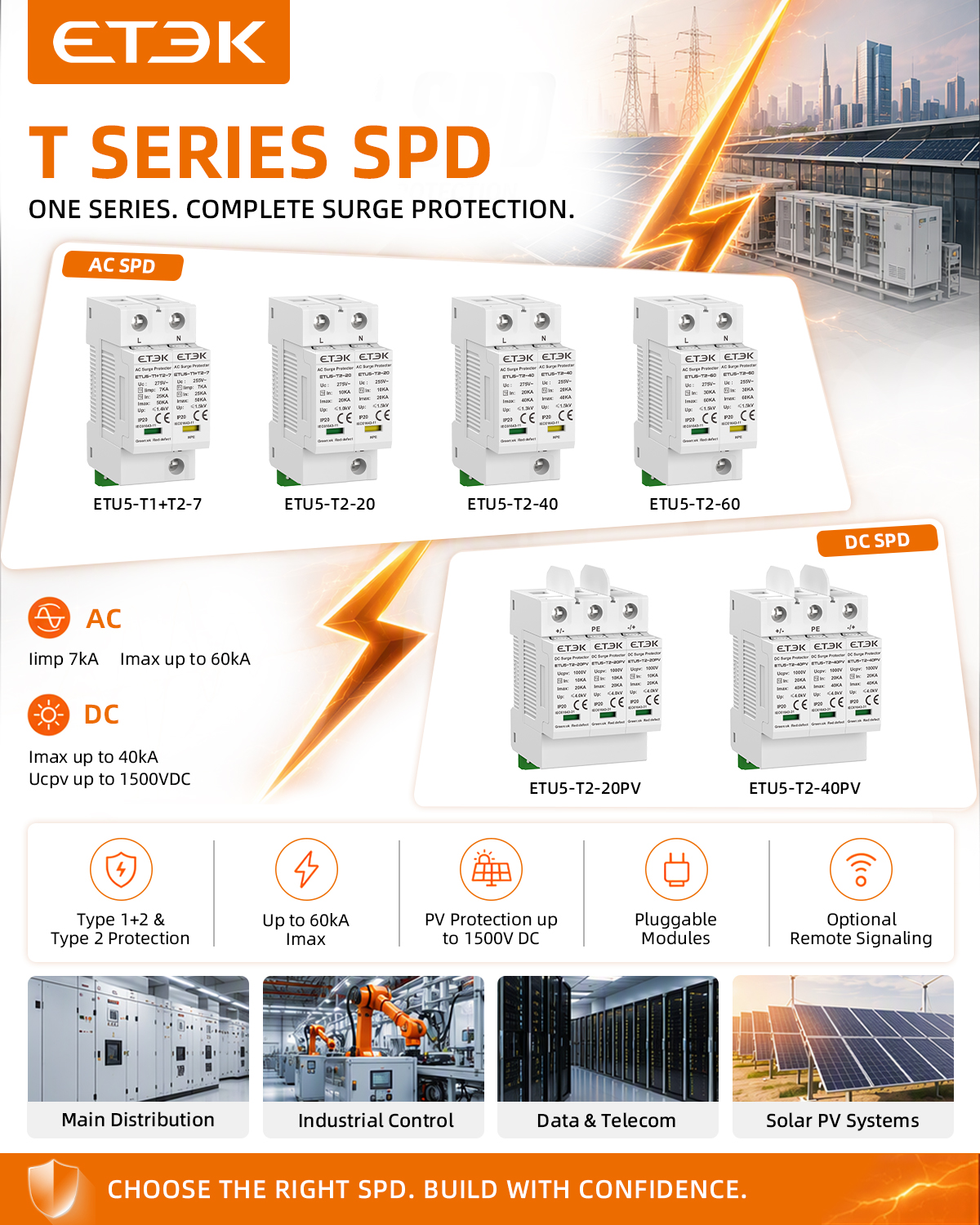
Off-the-shelf surge protectors rarely fit the unique demands of critical electrical systems—whether it’s a non-standard voltage, harsh environment, or space constraint. That’s where custom engineering makes the difference. ETEK designs and builds surge protective devices around your exact specifications, delivering protection that generic units simply can’t match. In the sections ahead, we’ll explore how tailored SPDs safeguard your most vital equipment from unpredictable power anomalies.
Why Off-the-Shelf Surge Protectors Fall Short in Critical Environments
Most plug-in surge protectors sold for home offices or retail spaces are built around a simple assumption: the incoming power is already fairly clean, and occasional spikes are the exception. Critical environments rarely work that way. Hospitals, data centers, and industrial control rooms deal with constant load switching, variable frequency drives, and aging infrastructure that create repeated transients and high-energy surges. The metal oxide varistors inside a typical off-the-shelf unit have limited joule ratings and can degrade after a handful of events, leaving downstream equipment exposed without any visible warning. When a 20,000-amp surge hits a surgical robot or a server cluster, a device designed for a coffee maker simply cannot clamp the voltage fast enough or low enough to prevent damage.
Another often-overlooked weakness is the lack of real-time status monitoring and fail-safe behavior. In critical facilities, a failed surge protector is not just an inconvenience; it can silently remove protection from life-safety systems or production lines. Most consumer-grade strips use simple indicator lights that may not reflect thermal damage or a blown internal fuse. They also lack remote alarm contacts, replaceable modules, or coordination with backup power systems. As a result, technicians may believe a circuit is still protected when it is actually running bare. High-quality industrial suppressors, by contrast, are designed to disconnect safely, signal a fault, and maintain a known failure state so maintenance teams can respond before the next surge hits.
Physical installation requirements add another layer of trouble. Off-the-shelf surge protectors often come in plastic enclosures with cord-and-plug connections that are not suited for panel mounting, DIN rails, or hardwired branch circuits common in critical infrastructure. They can introduce unwanted series impedance, conflict with isolated ground systems, or fail to meet strict fire codes for plenum spaces. In a data center or a wastewater treatment plant, the ability to place surge suppression close to the load—or at the service entrance with proper coordination—is essential. Standard retail products rarely offer the clamping voltage, response time, and mechanical ruggedness needed for such installations, forcing facility managers to either risk using inadequate protection or invest in engineered solutions from the start.
Mapping Your Facility’s Unique Surge Exposure Points
Every facility carries its own hidden pinch points when patient volume spikes. Start by walking the actual flow—from ambulance bay to discharge—and note where queues form, where supplies run thin, and where staff repeatedly get pulled away from core duties. A busy emergency department might look like the obvious stress point, but the real bottleneck often sits in imaging turnaround, lab result delays, or a pharmacy that can’t keep up with medication orders.
Mapping these exposures isn’t a one-time exercise. Surge patterns shift with the season, local outbreaks, and even construction projects that temporarily close a corridor or reduce holding space. Use simple floor-plan annotations and daily huddle notes to track recurring friction. The goal isn’t to produce a polished report—it’s to give your team a shared mental model of where the system starts to bend before it breaks.
Pay special attention to interdependent failures. A surge in respiratory cases might not only fill isolation rooms but also overload portable oxygen supplies and exhaust staff who need fit-testing for respirators. When you map these linked exposure points, you can stage resources in advance and cross-train staff so one overwhelmed area doesn’t quietly drag down the entire facility.
Custom Voltage Thresholds and Response Curves That Match Your Load Profile
Every load has its own voltage behavior during startup, steady state, and shutdown. A fixed threshold forces you to choose between nuisance trips on inrush currents and dangerously slow reactions to real faults. By dialing in custom voltage limits and shaping the response curve, the protection follows the actual signature of your equipment instead of fighting it.
Think about a motor load with a brief dip when it kicks on. A generic undervoltage setting might flag that normal event as a problem. With a customized curve, you can widen the tolerance for the first few hundred milliseconds, then tighten it once the system settles. The same logic applies to sensitive electronics that need fast disconnection on small deviations but can ride through short transients.
The result is fewer false alarms, less downtime, and protection that feels transparent in operation. You are not constantly adjusting settings to accommodate one oddball load. Instead, the thresholds and timing are set once, based on how the load actually behaves, and the system responds predictably from then on.
Designing SPDs for Harsh, Space-Constrained, or Legacy Installations
When an SPD is destined for a harsh environment, the design brief shifts away from generic performance figures and toward survival. High ambient temperatures accelerate varistor ageing, while dust, salt spray, and condensation invite tracking and corrosion across terminals and PCB traces. In these settings, fully encapsulated modules with wide creepage distances and sealed, vibration-resistant terminations become non-negotiable. Thermal disconnectors must be tuned to trip before a heavily coated MOV can overheat, and indicator windows need to remain legible under UV and grime. Materials selection matters as much as circuit topology: a plated steel housing that works in a clean electrical room may fail within months on a coastal pumping station.
Space-constrained installations punish bulky designs. A surge protector that consumes too much DIN rail width or protrudes deep into a cabinet forces installers into awkward cable bends and blocked ventilation paths. Compact SPDs achieve their size through tightly packed multi-layer varistor stacks and custom electrode geometries, not simply by shrinking the enclosure. Pluggable modules help when replacement must happen without disturbing adjacent wiring, but the base footprint still has to accommodate high-current paths without excessive heat. Clever use of vertical space, rather than rail width, allows a narrow device to carry the same discharge rating as a wider rival while leaving room for a remote signaling contact.
Legacy installations bring a different set of constraints. Panels built decades ago may lack a DIN rail entirely, or have odd busbar spacing, or rely on fuses with characteristics that no longer match modern SPD short-circuit ratings. Designers need mounting options that can clamp to a chassis, sit on a flat plate, or use adapters without compromising the ground bond. The SPD’s voltage protection level must also respect the reduced dielectric strength of older insulation, while its internal overcurrent protection has to coordinate with legacy breakers that may be slower or faster than expected. This is less about raw performance and more about interoperability: the device should slip into an aging system without demanding that the system change around it.
Collaborative Engineering: From Risk Assessment to Prototype and Field Validation
Early collaboration pays off most when risk assessment is treated as a shared, ongoing conversation rather than a standalone gate. Design engineers, manufacturing specialists, and field technicians sit together to map failure modes, rank them by both likelihood and operational impact, and agree on which risks need immediate design changes versus those that can be monitored through prototyping. This process often uncovers hidden dependencies—like how a seemingly minor material choice affects vibration damping in the field—that would otherwise surface only after costly tooling is committed.
Once risks are prioritized, prototyping becomes a vehicle for cross-functional learning. Teams build not one prototype but a series of focused test rigs and functional mockups, each designed to answer specific questions raised during risk assessment. For example, a thermal management concern might lead to a simplified heat exchanger prototype tested under worst-case ambient conditions, while a separate ergonomic mockup gathers operator feedback in parallel. These parallel streams compress the timeline because failures are isolated early and do not cascade into a single high-stakes integration test.
Field validation is where the collaborative loop closes. Instead of handing off a finished design to a validation team, the original risk owners—designers, analysts, and field engineers—review test data together against the initial risk register. Discrepancies between predicted and observed behavior trigger targeted root-cause discussions, sometimes leading to rapid design tweaks that are re-validated in a follow-up field trial. This shared ownership keeps the risk assessment living and credible, rather than a document that gets archived after the design review.
Lifecycle Support and Retrofitting as Your Electrical Infrastructure Evolves
Facilities rarely stand still. Loads shift, equipment ages, and what met code a decade ago may now fall short of both safety expectations and operational reality. Lifecycle support begins with a thorough condition assessment—thermal imaging, breaker timing tests, protective relay calibration—not as a one-off audit but as a living baseline. From there, we map degradation trends against your actual usage patterns. A transformer that's lightly loaded today might be the weak link after a planned expansion; knowing its remaining insulation life lets you budget for replacement before it dictates an emergency outage.
Retrofitting isn't about ripping out everything old in favor of new. Often the smartest path is selective modernization: upgrading trip units on legacy breakers, adding partial discharge monitoring to aging switchgear, or replacing outdated relays with multifunction devices that communicate over existing wiring. This approach respects both capital constraints and downtime windows. We've seen facilities extend the service life of 30-year-old switchgear by a decade through targeted instrumentation and firmware updates—without ever taking the main bus offline during production hours.
The real difference comes from treating documentation and training as part of the retrofit, not an afterthought. As-built drawings drift, settings get tweaked by multiple hands, and institutional knowledge walks out the door when a senior technician retires. Our lifecycle support includes updating single-line diagrams after every change, storing relay configuration files in a versioned repository, and walking your team through the "why" behind each setting. That way, the next upgrade doesn't start from a mystery—it starts from an accurate, current picture of your electrical backbone.
FAQ
A custom SPD is engineered around the specific voltage, footprint, and fault current requirements of a system, so it fits both physically and electrically without forcing compromises in protection levels or wiring layout.
Systems with unusual bus configurations, legacy switchgear, high DC voltages, or sensitive control circuits often need custom SPDs. Examples include power plants, water treatment facilities, military installations, and industrial automation lines.
It starts with a risk assessment of the location's exposure to lightning or switching transients, then selection of the appropriate surge current capacity per phase and voltage protection rating so the device remains within its safe operating envelope.
Yes, custom designs frequently handle mixed AC/DC environments, including DC battery banks, solar arrays, and drive systems, using appropriate metal oxide varistor or gas discharge tube configurations for each circuit type.
The main benefits are a closer voltage protection level, less need for field modifications, simplified replacement planning, and better coordination with upstream breakers or fuses, which reduces nuisance tripping and extends equipment life.
They are typically designed and tested to align with relevant parts of IEC 61643 or UL 1449, depending on the installation region, and may also be verified for specific environmental conditions like humidity, dust, or vibration.
Custom units generally involve an engineering review and approval drawing phase, so lead times may run several weeks longer than standard products. However, the upfront planning usually saves time during installation and commissioning.
Usually you need the system voltage, number of phases, grounding scheme, available short-circuit current, physical space constraints, and any special termination or enclosure requirements. Providing a one-line diagram helps the design team avoid guesswork.
Conclusion
In critical electrical systems, the idea that a standard surge protector can handle every risk is often the weakest link in a resilience plan. Off-the-shelf devices are built around generic assumptions about voltage, exposure, and enclosure size, which rarely match the reality of a chemical plant’s outdoor junction boxes, a hospital’s legacy switchgear, or a data hall’s high-density busway. Mapping your facility’s unique surge exposure points isn't a paperwork exercise—it's how you discover that a modest compressor start can generate transients far more damaging than a distant lightning strike. When protection is custom engineered, the voltage threshold and response curve are tuned to your actual load profile, so the SPD clamps exactly when needed and stays quiet during normal operation. This avoids nuisance tripping and premature aging, while still shunting destructive energy before it reaches sensitive electronics.
Custom design also solves physical challenges that standard units can't touch. Harsh, space-constrained, or legacy installations demand creative form factors, alternative mounting, and conductor routing that don't show up in a catalog. Working with an engineering partner shifts the process from guessing to a structured risk assessment, where prototypes are subjected to field validation with your real fault currents and ambient temperatures. The result is a surge protective device that fits the available space, tolerates chemical splash or extreme heat, and doesn't require rewiring half the facility. And because infrastructure evolves, lifecycle support and retrofitting become part of the agreement—when you add new drives, change switchgear, or expand a line, the protective scheme can be re-tuned without starting over. This keeps the electrical backbone protected not just today, but through every upgrade and expansion you'll face.
Contact Us
Contact Person: Andy
Email: [email protected]
Tel/WhatsApp: +86 13356133008
Website: https://www.etek-china.com/