

China Arc Fault Detection Device Technologies for Enhanced Fire Protection
2026-10-02
Electrical fires remain a silent threat in modern buildings, often sparked by arc faults that conventional breakers fail to detect. In response, China has accelerated the adoption of advanced arc fault detection devices, reshaping how we think about fire protection. At the forefront of this shift is ETEK, a brand that combines precision engineering with real-world safety demands. This article explores the technologies driving China's arc fault detection landscape and why they matter for enhanced fire protection.
Arc Signature Recognition in Chinese Residential Circuits
In Chinese residential circuits, the detection of arc signatures plays a critical role in preventing electrical fires. Unlike industrial settings, home wiring often carries mixed loads ranging from high-inrush devices like air conditioners to sensitive electronics. A fault arc produces distinctive high-frequency current spikes and voltage distortions, yet these patterns must be separated from normal operational transients caused by switching appliances or motor starts.
Feature extraction commonly relies on time-frequency analysis, with wavelet transforms proving effective for capturing the transient bursts typical of series arcs in 220V/50Hz systems. Researchers have found that Chinese household appliances, particularly older refrigerators and fluorescent ballasts, generate background noise that overlaps partially with arc signatures. To address this, multi-resolution decomposition combined with statistical metrics like kurtosis and crest factor helps isolate true arc events from periodic load fluctuations.
The main challenge lies in distinguishing harmless arcs from dangerous ones, such as those occurring in loose connections or damaged insulation. Practical systems employ adaptive thresholding and machine learning classifiers trained on real-world data collected from Chinese apartments, where wiring ages and aluminum conductors present unique impedance characteristics. By focusing on the energy distribution across specific frequency bands, modern detectors can achieve reliable recognition without excessive false trips, a common complaint in older AFCIs.
Why China's Fire Safety Codes Now Push Arc Fault Detection
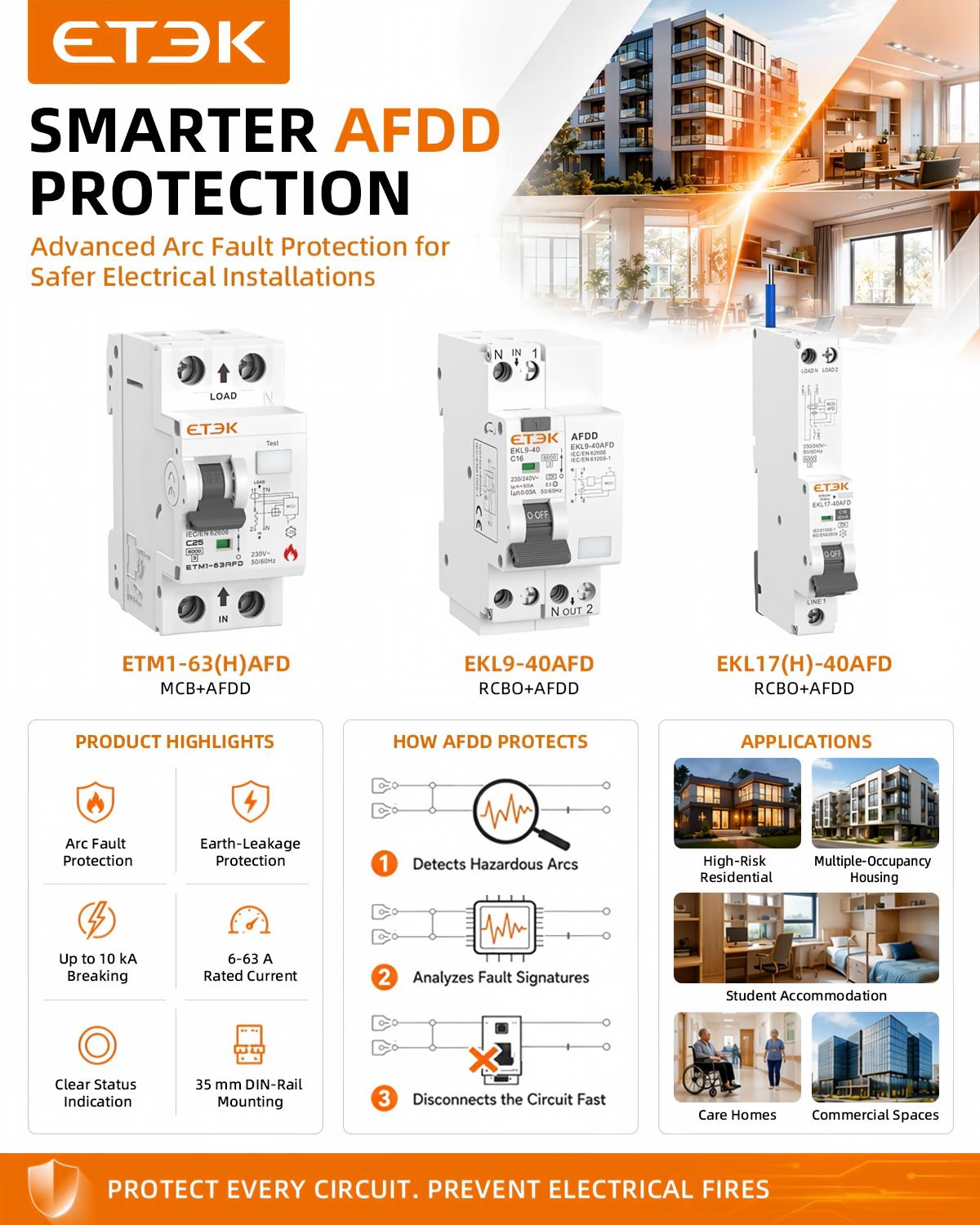
China's rapid urbanization brought a surge in electrical wiring inside older buildings and new high-rises alike, but conventional circuit breakers struggle to catch the subtle, smoldering arcs that often precede a full-blown fire. A loose terminal, a frayed cable behind a wall, or a rodent-damaged conductor can sustain an arc without ever tripping a standard overcurrent device. Fire statistics from several major cities pointed the same way: a large share of structural fires traced back to electrical faults that never registered on existing protection. That gap pushed regulators to look beyond simple overload and short-circuit defense.
The shift also reflects a maturing domestic manufacturing base. Early arc fault detection devices were mostly imported, making widespread code mandates impractical for cost reasons. Over the past decade, Chinese manufacturers developed reliable AFDDs tailored to local voltage levels and installation habits, bringing prices down enough for inclusion in national standards. Once the technology became affordable and could be tested against China's own grid conditions, code committees moved from cautious pilot projects in hotels and hospitals to broader residential and commercial requirements.
There is also a growing awareness that fire safety cannot rely solely on evacuation routes and sprinklers when the ignition source is hidden inside walls. Electrical fires often start hours after a poor connection heats up, when occupants are asleep or away. Arc fault detection interrupts that timeline by recognizing the unique current signature of an arcing fault and cutting power before ignition. For a country with dense residential towers and aging wiring stock, embedding this protection into the fire safety code is less a niche upgrade and more a structural necessity.
Suppressing Nuisance Trips from Motors and Dimmers
Motors can pull six to eight times their running current during startup, and that brief inrush often looks like a short circuit to a standard breaker or ground-fault protector. Dimmers, especially leading-edge phase-control types, add high-frequency switching noise and voltage spikes that ride along the branch circuit. These transients are rarely dangerous, but they are enough to confuse protective devices and trigger trips that have nothing to do with an actual fault.
One practical approach is to separate dimmer and motor loads onto different circuits so they do not share a common protection device. Where separation is not possible, using a breaker with a delayed trip curve or one rated for motor starting can be much more tolerant of inrush. Adding a filter at the dimmer output or switching to a trailing-edge dimmer also cuts down the harmonic noise that tends to couple into protection electronics.
For stubborn cases, a soft starter or an inrush limiter on the motor can reduce the current spike before it reaches the breaker. Snubbers and surge suppressors across dimmer outputs help absorb voltage transients, while proper grounding and shielded control wiring prevent noise from leaking into adjacent circuits. Also check for loose terminations, since intermittent arcing at a connection can imitate a ground fault or overload and cause nuisance trips that no breaker upgrade will fix.
AFDDs for High-Rise Residential and Dense Urban Grids
High-rise residential towers and tightly packed urban grids introduce a unique set of electrical hazards. Arc faults can develop behind walls, in utility closets, or within shared risers where inspection access is limited. In these environments, a small undetected arc can escalate rapidly, fueled by continuous power demands from hundreds of dwelling units and common services. Traditional circuit breakers only respond to overloads and short circuits, leaving low-current arc signatures to smolder until they reach combustible thresholds.
Arc Fault Detection Devices (AFDDs) address this blind spot by continuously monitoring the waveform for unstable, high-frequency current patterns typical of arcing. Their value becomes especially pronounced in dense residential layouts, where a single incident on one floor can affect evacuation routes, vertical shafts, and adjacent units. Installing AFDDs at distribution boards for individual apartments and shared facilities reduces the likelihood of a localized fault growing into a building-wide emergency.
Beyond safety gains, AFDDs help property managers and owners meet evolving electrical codes that increasingly mandate arc fault protection in sleeping areas and high-occupancy buildings. Retrofitting older towers with these devices can be phased floor-by-floor, minimizing disruption while progressively raising the baseline of fire resilience. In cities where every square meter counts, the compact footprint of modern AFDDs fits readily into crowded panelboards without sacrificing performance or diagnostic detail.
Combined Arc, Leakage, and Overcurrent Protection Modules
Combining arc fault, earth leakage, and overcurrent protection into a single module cuts wiring time and panel clutter without compromising safety. Instead of three separate devices competing for DIN rail space, one compact unit monitors all three fault types simultaneously, which is particularly useful in retrofits where every centimetre counts.
The detection logic inside these modules isn't just three circuits bolted together. Arc faults are identified by high-frequency current signatures, leakage is sensed via a residual current transformer watching for imbalance between line and neutral, and overcurrent uses a thermal-magnetic or electronic trip curve. The real value comes when the electronics coordinate these responses—for example, suppressing a nuisance arc trip during a brief motor inrush while still catching a true series arc.
Field applications range from residential distribution boards where space is tight to electric vehicle chargers and solar inverters that demand fast, selective disconnection. Because the protective functions share a common microcontroller, installers can often adjust sensitivity thresholds and reset behaviour locally, reducing call-backs and simplifying fault diagnosis compared with older discrete setups.
Cloud-Connected Panels and Early Fire Risk Prediction
Modern electrical panels now stream real-time data to cloud platforms, capturing subtle patterns that hint at trouble long before smoke ever appears. Instead of relying on periodic inspections, these systems monitor arc signatures, thermal drift, and load imbalances around the clock. The cloud layer correlates this feed with historical norms for the specific building, filtering out harmless fluctuations while flagging anomalies that human eyes would miss.
Early fire risk prediction moves beyond simple threshold alarms. Machine learning models trained on millions of circuit events learn to recognize the pre-failure fingerprints of loose connections, degrading insulation, or faulty breakers. When a panel deviates from its own baseline, the cloud service can issue a graded alert, giving maintenance teams enough lead time to tighten a terminal or replace a component during off-hours rather than scrambling after a trip or worse.
This approach shifts electrical safety from reactive to preemptive. Building managers receive plain-language notifications with suggested actions, while the underlying data remains available for forensic review. Over time, the predictive engine refines its accuracy for each site, reducing nuisance calls and catching risks that traditional thermal imaging or scheduled maintenance would likely overlook.
FAQ
Many units combine high-frequency current signature analysis with microprocessor-based pattern recognition. They sample at high rates, look for chaotic zero-crossing behavior and broadband noise, and compare against learned signatures of nuisance sources like brush motors or dimmers.
The standard sets performance criteria for arc fault detection including clearing times, immunity to false tripping from common appliances, and endurance testing. Manufacturers align product design with these protocols to gain market access and demonstrate reliable protection.
Aging aluminum connections are prone to oxidation and loosening, creating high-resistance points that generate series arcs without drawing high current. Arc fault detectors catch these low-level erratic signals before they escalate into smoldering fires.
Combined devices detect both parallel arc faults and ground leakage currents in one module, reducing panel space and installation cost. They share a trip mechanism but use separate detection channels to avoid compromising either safety function.
They deploy adaptive learning algorithms that record the electrical noise fingerprint of connected loads during commissioning. Subsequent arc detection uses this baseline to suppress nuisance trips while retaining sensitivity to genuine arc signatures.
DC string arcs on rooftop solar arrays can persist without overcurrent protection. Arc fault detectors designed for DC systems monitor series and parallel arcs, disconnect affected strings, and help meet fire safety requirements in dense urban solar deployments.
Series arcs occur along a single conductor at a loose connection, carrying normal load current with lower amplitude and harder-to-detect signatures. Parallel arcs jump between line and neutral or ground, producing higher current spikes and often easier thermal signatures. Detectors use different filtering and threshold logic for each.
They build datasets from real appliance operation and controlled arc generators, then train convolutional or recurrent neural networks on time-frequency representations. The resulting classifiers show higher accuracy than fixed threshold methods, especially for mixture loads like air conditioners plus switch-mode power supplies.
Conclusion
Electrical fires in China's residential buildings have long been driven by loose connections, aging wiring, and the growing number of appliances that draw irregular currents. Traditional circuit breakers only react to overloads and short circuits, leaving dangerous arc faults undetected. Recent Chinese arc fault detection devices (AFDDs) address this gap by continuously sampling high-frequency current waveforms and matching them against fault signatures typical of residential circuits. Unlike generic algorithms developed for other markets, these devices are tuned to the specific load profiles found in Chinese homes—frequent use of induction cookers, air conditioners, and plug-in EV chargers. This local adaptation has made arc recognition markedly more reliable in densely packed apartment buildings where branch circuits share neutral lines and voltage quality can fluctuate.
China's updated fire safety codes are now requiring AFDDs in high-rise residential and other high-risk occupancies, which has pushed manufacturers to solve a persistent problem: nuisance tripping from motors, dimmers, and switch-mode power supplies. The latest designs use adaptive thresholds and time-frequency analysis to distinguish harmless operational arcs from hazardous ones, so a vacuum cleaner or LED dimmer no longer triggers false alarms. Beyond standalone protection, many panels now integrate arc, leakage, and overcurrent detection into a single module, simplifying installation and reducing panel footprint. At the grid edge, cloud-connected distribution boards collect trip events and load signatures, feeding predictive models that flag aging wiring or deteriorating connections before they cause a fire. This shift from reactive circuit interruption to proactive risk scoring is quietly reshaping how Chinese property managers and utilities approach electrical fire prevention.
Contact Us
Contact Person: Andy
Email: [email protected]
Tel/WhatsApp: +86 13356133008
Website: https://www.etek-china.com/